

Gut Health 101: Fibre, Fermented Foods, and Your Kid's Microbiome
Written by Vivian Pilibbossian, Nutrition Student
What Is a Healthy Gut Microbiome?
Digestive health has become a big topic in nutrition research lately. Scientists are interested in how the foods kids eat, particularly fibre, impact things like digestion, bathroom habits, and the bacteria living in their gut.
A healthy gut microbiome isn't just about finding one "good" bacteria that fixes everything. It's about diversity; having a wide range of bacteria in the gut, since different ones support the body in different ways.
Fibre supports good gut diversity because it's what keeps those bacteria fed and thriving.
The benefits go well beyond digestion. Diets higher in fibre have been linked to lower risks of diabetes, obesity, high blood pressure, stroke, heart disease, and digestive disorders.
Fibre also helps kids stay regular, supports a healthy weight, and strengthens the immune system. So building good gut health early isn't just about short-term comfort; it shapes a child's long-term health.
Why Gut Health Matters for Kids
A healthy gut is about more than just smooth digestion; it affects how well your child's body absorbs nutrients, how they fight off illness and how they feel from day to day. Fibre is one of the most practical things parents can focus on, and it actually works in two different ways.
Insoluble fibre doesn't break down in water. It bulks up stool and helps keep things moving through the gut, which is an effective, simple way to prevent constipation.
Soluble fibre works a bit differently. Some of it turns into a gel as it moves through the digestive tract, which can firm up loose stool, soften constipated stool, and even help with blood sugar and cholesterol.
There's also a type of soluble fibre, sometimes called prebiotic or fermentable fibre, that doesn't get digested at all. Instead, it becomes food for the good bacteria in your child's gut, which helps them thrive and, in turn, supports the immune system.
How Much Fibre Does My Child Need?
Kids need more fibre as they get older. Health Canada's guidelines give a rough sense of what to aim for:
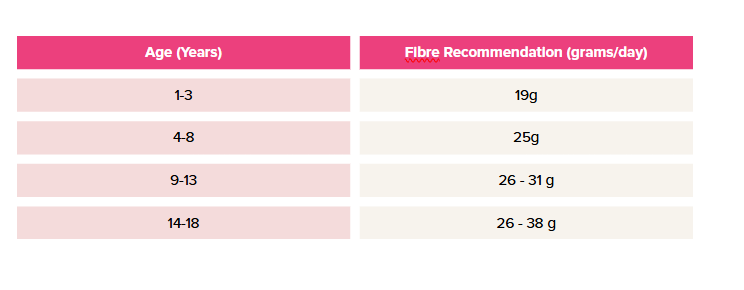
Source: Alberta Health Services (2020)
Note: these numbers are general estimates; talk to your child's healthcare provider about what's right for them specifically.
Avoid increasing fibre too fast. A sudden increase in fibre can lead to gas, bloating, or an upset stomach, so give your child's body some time to adjust. Water matters as much as fibre does; without enough of it, extra fibre can make constipation worse instead of better. As a rough guide, kids aged 2-8 need about 4-5 cups of fluid a day, 9-13-year-olds need closer to 6-7 cups, and teens need about 7-10 cups. Staying active helps, too; regular movement supports digestion all on its own.
Good Sources of Fibre for Kids
Grains: Whole-wheat bread and pasta, oatmeal, brown rice, quinoa, and barley all contain far more fibre than refined white varieties. Look for cereals with "bran," "whole," or "fibre" right on the label.
Fruits and vegetables: Pears and apples (skin on), mangoes, berries, and dried fruit like apricots or prunes are all strong choices. For vegetables, green peas, snow peas, and Swiss chard are at the top of the list. Whole fruit will always give your child more fibre than juice, which has very little.
Legumes, nuts, and seeds: Lentils, chickpeas, and beans are among the richest sources of fibre, and they also provide a good source of protein. Peanut butter counts too; a single tablespoon has close to 3 grams of fibre, making it an easy addition to toast or crackers. (Note: whole nuts and seeds are a choking hazard for kids under four, so stick to nut and seed butters.)
A few easy meal ideas (because it doesn't have to be complicated):
Breakfast: oatmeal, whole wheat toast with peanut butter, or yogurt with berries and granola
Lunch: a whole wheat wrap with chicken and brown rice, or a bowl of lentil soup with whole wheat crackers
Dinner: whole wheat pasta with vegetables, or a lentil curry
Snacks: popcorn (for kids over four), apple slices with nut butter, or whole wheat pita with hummus
Fibre for Picky Eaters: A Gentle Introduction
If your child is a picky eater, boosting their fibre intake doesn't mean introducing a bunch of new foods all at once. Small changes go a long way.
Ground flaxseed or chia seeds stirred into a smoothie your child already likes barely changes the taste or texture.
Lentils blended into pasta sauce tend to disappear completely.
Swapping familiar foods for whole-grain versions, such as bread, crackers, and pasta, is usually easier than trying something brand new.
Dried fruit, like raisins or dried apricots, makes a naturally sweet snack, and a thin spread of peanut butter on toast or crackers your child already eats is an easy, stress-free addition.
Fermented foods are another gentle way into gut-friendly eating. Check out our content from the fermentation alumni network.
The Bottom Line
At the end of the day, a healthy gut doesn't take a complete diet makeover; just a few small, consistent changes that add up over time.
Whether it's swapping in a whole grain, adding a handful of berries, or sneaking some chia seeds into a favourite smoothie, every little bit helps. Give it time, stay consistent, and it makes a big difference for long-term gut health.
Looking for more ways to add fibre to family meals? Check out our blog, Small Changes, Big Benefits: How to Add More Fibre to Family Meals.
References:
Oxford Academic (Korczak et al.), "Dietary fibre and digestive health in children"
Alberta Health Services (Nutrition Services), "Eat more Soluble Fibre"
AboutKidsHealth (Sick Kids), "Higher-fibre diet"
Alberta Health Services (Nutrition Services), "Fibre Facts"
La santé intestinale 101: les fibres, les aliments fermentés et le microbiome de votre enfant
Écrit par by Vivian Pilibbossian, étudiante en nutrition
Qu’est-ce qu’un microbiome intestinal sain?
La santé digestive est devenue un sujet majeur dans la recherche en nutrition ces derniers temps. Les scientifiques s'intéressent à la manière dont les aliments consommés par les enfants, en particulier les fibres, influent sur des aspects tels que la digestion, les habitudes de selles et les bactéries présentes dans leur intestin.
Un microbiome intestinal sain ne se résume pas à la recherche d’une seule « bonne » bactérie qui résoudrait tous les problèmes. C’est une question de diversité: il s’agit d’avoir une grande variété de bactéries dans l’intestin, car chacune d’entre elles soutient l’organisme a sa manière.
Les fibres favorisent une bonne diversité intestinale, car elles nourrissent ces bactéries et leur permettent de prospérer.
Leurs bienfaits vont bien au-delà de la digestion. Une alimentation riche en fibres est associée à une réduction des risques de diabète, d'obésité, d’hypertension, d’accident vasculaire cérébral, de maladies cardiaques et de troubles digestifs.
Les fibres aident également les enfants à maintenir un transit régulier, favorisent un poids santé et renforcent le système immunitaire. Ainsi, favoriser une bonne santé intestinale dès le plus jeune âge ne se résume pas à un simple confort à court terme; cela façonne la santé à long terme de l’enfant.
Pourquoi la santé intestinale est-elle importante pour les enfants?
Un intestin en bonne santé ne se résume pas à une simple digestion sans problème; il influe sur la capacité de l’organisme de votre enfant à absorber les nutriments, sur sa capacité à lutter contre les maladies et sur son bien-être au quotidien. Les fibres constituent l’un des éléments les plus concrets sur lesquels les parents peuvent se concentrer, et elles agissent en fait de deux façons différentes.
Les fibres insolubles ne se dissolvent pas dans l’eau. Elles augmentent le volume de selles et favorisent le transit intestinal, ce qui constitue un moyen simple et efficace de prévenir la constipation.
Les fibres solubles agissent un peu différemment. Une partie d’entre elles se transforme en gel lorsqu’elles traversent le tube digestif, ce qui permet de raffermir les selles molles, d’assouplir les selles dures en cas de constipation et même de contribuer à réguler la glycémie et le cholestérol.
Il existe également un type de fibre soluble, parfois appelée fibre prébiotique ou fermentable, qui n’est pas du tout digérée. Elle sert plutôt de nourriture aux bonnes bactéries présentes dans l’intestin de votre enfant, ce qui les aide à se développer et, par conséquent, renforce le système immunitaire.
De quelle quantité de fibres mon enfant a -t-il besoin?
Les enfants ont besoin de plus de fibres à mesure qu’ils grandissent. Les lignes directrices de Santé Canada donnent une idée approximative des quantités à viser:
Remarque: ces chiffres sont des estimations générales; consultez le professionnel de santé de votre enfant pour déterminer ce qui lui convient le mieux.
Évitez d’augmenter trop rapidement l’apport en fibres. Une augmentation soudaine de la consommation de fibres peut entraîner des gaz, des ballonnements ou des maux d’estomac, donc laissez au corps de votre enfant le temps de s’adapter. L’eau est tout aussi importante que les fibres; sans un apport suffisant en eau, un surplus de fibres peut aggraver la constipation au lieu de l'atténuer. À titre indicatif, les enfants de 2 à 8 ans ont besoin d’environ 4 à 5 tasses de liquide par jour, ceux de 9 à 13 ans ont besoin d’environ 6 à 7 tasses, et les adolescents ont besoin d’environ 7 à 10 tasses.
Bonnes sources de fibres pour les enfants
Les céréales: Le pain et les pâtes de blé entier, les flocons d’avoine, le riz brun, le quinoa, et l’orge contiennent tous beaucoup plus de fibres que leurs variétés blanches raffinées. Recherchez des céréales dont l'étiquette porte les mentions « son », « entier » ou « fibres ».
Les fruits et les légumes: Les poires et les pommes (avec la pluche), les mangues, les baies, les fruits séchés comme les abricots ou les pruneaux constituent tous d’excellents choix. Pour les légumes, les petits pois, les pois mange-tout, et les bettes à carde figurent en tête de liste. Les fruits entiers apporteront toujours plus de fibres à votre enfant que le jus, qui en contient très peu.
Les légumineuses, les noix et les graines: Les lentilles, les pois chiches, et les haricots comptent parmi les sources les plus riches en fibres, et constituent également une bonne source de protéines. Le beurre d’ arachide en fait également partie; une seule cuillère à soupe contient près de 3 grammes de fibres, ce qui en fait un accompagnement facile à ajouter à un pain grillé ou aux craquelins. (Remarque: les noix entières et les graines présentent un risque d'étouffement pour les enfants de moins de 4 ans; privilégiez donc les beurres de noix et graines.)
Quelques idées de repas faciles (car ca n’a pas besoin d'être compliqué):
Déjeuner: le gruau, le pain grillé de blé entier avec du beurre d’arachide, ou le yogourt aux baies et au granola.
Dîner: un wrap de blé entier au poulet et au riz brun, ou un bol de soupe aux lentilles accompagné de craquelins de blé entier.
Souper: les pâtes de blé entier aux légumes, ou un cari de lentilles.
Collations: le pop-corn (pour les enfants de plus de 4 ans), les tranches de pomme avec du beurre de noix, ou pain pita de blé entier avec du houmous.
Les fibres et l’alimentation sélective: une introduction en douceur
Si votre enfant a une alimentation sélective, augmenter son apport en fibres ne signifie pas pour autant lui faire découvrir une multitude de nouveaux aliments d’un seul coup. Des petits changements peuvent faire toute la différence.
Des graines de lin moulues ou des graines de chia incorporées à un smoothie que votre enfant apprécie déjà ne modifient pratiquement pas le goût ni la texture.
Les lentilles incorporées à une sauce à pâtes ont tendance à se fondre complètement dans le mélange.
Remplacer des aliments familiers par des versions à grains entiers, comme le pain, les craquelines, et les pâtes, est généralement plus facile que d’essayer quelque chose de complètement nouveau.
Les fruits séchés, comme les raisins secs ou les abricots séchés, constituent une collation naturellement sucrée, et une fine couche de beurre d’arachide sur du pain grillé ou des craquelins que votre enfant mange déjà est un ajout facile et sans tracas.
Les aliments fermentés constituent une autre façon en douceur d’adopter une alimentation favorable à la santé intestinale. Consultez notre contenu provenant du « Alumni Network » au programme de fermentation.
En résumé
En fin de compte, pour avoir l’ intestin en bonne santé, il n’est pas nécessaire de bouleverser complètement son alimentation; il suffit de quelques petits changements constants qui s’accumulent au fil du temps.
Qu’il s’agisse de remplacer un aliment par une version à grains entiers, d’ajouter une poignée de baies ou d’incorporer discrètement quelques graines de chia dans un smoothie préféré, chaque petit geste compte. Donnez-vous du temps, restez constant, et cela fera une grande différence pour la santé intestinale à long terme.
Vous cherchez d’autres façons d'intégrer des fibres dans les repas familiaux? Consultez notre blog, Petits changements, grands bienfaits: comment ajouter plus de fibres aux repas en famille.