

Understanding Different Types of Milk: How to Choose What Works for Your Family
Written by Tia Duesling
If you’ve stood in the milk aisle lately, you’ve probably noticed that the options extend far beyond “2%” or “whole.” Almond, oat, soy, coconut, lactose-free, fortified, and unsweetened are just some of the words you’ll see on cartons today. For many families, the variety can feel overwhelming.
You might be asking:
Is one healthier?
Is plant-based milk nutritious enough?
How can I use plant-based milks?
Is dairy milk necessary for my child to grow properly?
The answer is not the same for every household. Understanding where different milks come from and how they compare nutritionally can help you make a choice that fits your family’s needs, preferences, values, and budget.
Where Different Milks Come From (1,2,3)
Dairy milk comes from cows raised on farms. After milking, it is pasteurized to ensure safety, and in Canada it is fortified with vitamin D by regulation. It naturally contains protein, calcium, and several B vitamins.
To put it simply, plant-based beverages are typically made by blending a plant ingredient with water and straining the liquid. Store-bought versions may also include ingredients such as emulsifiers and stabilizers to help keep the beverage smooth and prevent separation.
Common varieties include:
Almond
Oat
Soy
Coconut
Most commercially available plant-based beverages are fortified with calcium and vitamin D so their nutrient profiles more closely resemble dairy milk, which can make them a more suitable everyday option compared to non-fortified varieties.
Nutrition: What Is Actually Different? (1,2,4,5,6,7)
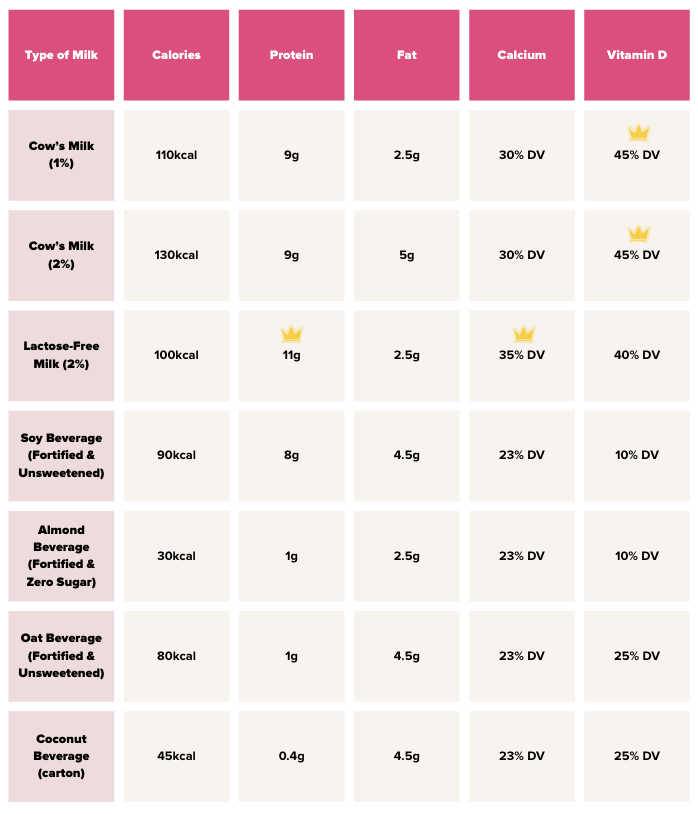
Rather than asking which milk is “best,” it is more helpful to ask what your family needs most from it. For example, cow’s milk and fortified soy beverages provide about 8 to 9 grams of protein per cup, while many almond, oat, and coconut beverages contain much less unless specifically formulated. If milk is an important source of protein in your child’s diet, that difference can matter.
Cow’s milk naturally contains calcium and is fortified with vitamin D in Canada. Many plant-based beverages are fortified with these nutrients as well, but the amounts vary by brand, so checking the Nutrition Facts table is important.
A Side-by-Side Look at Milk and Plant-Based Beverage Nutrition
The values in this table were gathered from the Nutrition Facts tables of common dairy milks and plant-based beverages available in Canadian grocery stores. They reflect typical fortified and unsweetened versions, but nutrition content can vary depending on the brand, flavour, and formulation.
This table is meant to provide a general comparison to help you think about how different options stack up in terms of protein, calories, and key nutrients.
A Note on Children’s Milk Consumption
For young children, adequate protein, fat, calcium, and vitamin D are important for growth and development. If you are unsure whether a different milk meets your child’s needs, speaking with a registered dietitian or health professional can be helpful.
Texture Matters: How Milk Choices Affect Cooking and Taste (7,8)
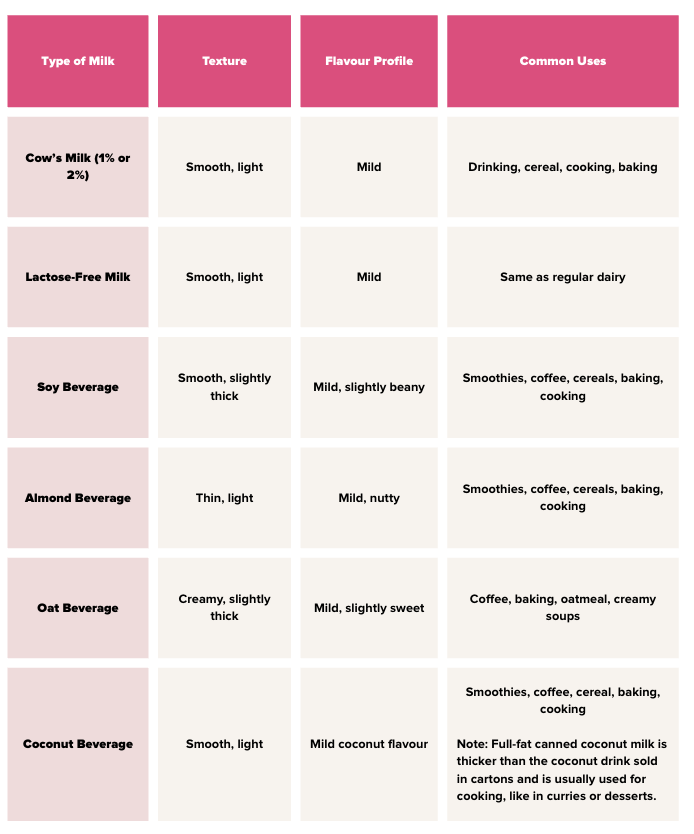
Nutrition is only one part of the decision. Texture and flavour can also make a big difference in how milk performs in your kitchen. Some milks are thin and light, while others are creamier or thicker. This affects how they blend in smoothies, foam in coffee, or hold up in baking and cooking.
The table below compares common dairy and plant-based beverages based on texture, flavour profile, and practical kitchen uses.
How Different Milks Perform in the Kitchen: Texture and Common Uses
Thinking About Sustainability (9,10)
Dairy production involves livestock, feed production, land use, water use, and greenhouse gas emissions. Plant-based beverages generally have lower greenhouse gas emissions and require less land overall.
However, environmental impact varies by product. For example:
Almond production can require significant water compared to other plant milks.
Oats and soybeans generally require less water and land compared to almonds.
There is no single perfect option. Sustainability also depends on the broader pattern of how we shop, cook, and reduce waste.
Cost and Accessibility
For many families, cost is just as important as nutrition or sustainability.
In Canada, dairy milk and plant-based beverages are widely available and often similarly priced. Cost can vary based on brand, fortification, and ingredients, so comparing prices and reviewing nutrition labels can help you assess overall value.
Building Food Literacy at Home (11)
Food decisions are shaped by more than just taste. They connect to nutrition, culture, budget, and personal values. Creating space at home to explore these factors together helps children understand how and why choices are made, rather than simply what to choose.
With your family, you can:
Compare protein amounts between products
Look at ingredient lists
Taste-test different options and discuss texture
Talk about where foods come from and how they are produced
These small conversations spark curiosity and encourage children to develop confidence and critical thinking around food choices.
Milk choices today reflect broader conversations about health, environment, and access. The goal is not to label one option as good or bad. It is to make an informed choice based on your needs. By understanding the differences, families can choose intentionally, based on what works best for them.
References
https://www.canada.ca/en/health-canada/services/fortified-food/canadas-approach.html
https://food-guide.canada.ca/en/tips-for-healthy-eating/sugar-substitutes-and-healthy-eating/
https://food-guide.canada.ca/en/applying-guidelines/nutrition-considerations-children-adolescents/
https://albertacancer.ca/leap-magazine/choosing-the-right-milk-alternative/
Comprendre les différents types de lait: comment choisir celui qui convient à votre famille
Écrit par Tia Duesling
Si vous vous êtes récemment retrouvé dans le rayon des produits laitiers, vous avez sans doute remarqué que les choix vont bien au-delà du lait «2%» ou du lait entier. Amande, avoine, soya, noix de coco, sans lactose, enrichi et non sucré ne sont que quelques-uns des termes que l’on trouve aujourd’hui sur les emballages. Pour de nombreuses familles, tous ces choix peuvent sembler déroutants.
Vous vous posez peut-être les questions suivantes:
Lequel est le plus sain?
Les boissons végétales sont-elles suffisamment nutritives?
Comment puis-je utiliser les boissons végétales?
Le lait de vache est-il nécessaire à la bonne croissance de mon enfant?
La réponse n’est pas la même pour toutes les familles. Comprendre d’où proviennent les différents types de lait et de boissons végétales et comparer leur valeur nutritive peut vous aider à faire un choix qui correspond aux besoins, aux préférences, aux valeurs et au budget de votre famille.
D’où proviennent les différents types de lait? (1,2,3)
Le lait de vache est produit dans les fermes laitières. Après la traite, il est pasteurisé pour en assurer la salubrité et, au Canada, il est enrichi en vitamine D conformément à la réglementation. Il contient naturellement des protéines, du calcium et plusieurs vitamines du groupe B.
Pour simplifier, les boissons végétales sont généralement fabriquées en mélangeant un ingrédient d’origine végétale à de l’eau, puis en filtrant le mélange. Les versions vendues en magasin peuvent également contenir des ingrédients comme des émulsifiants et des stabilisants afin de maintenir une texture homogène et d’empêcher les ingrédients de se séparer.
Parmi les variétés courantes, on trouve:
Amande
Avoine
Soya
Noix de coco
La plupart des boissons végétales vendues dans le commerce sont enrichies de calcium et de vitamine D, ce qui rapproche leur profil nutritionnel de celui du lait de vache et peut en faire un choix plus approprié pour une consommation quotidienne que les versions non enrichies.
Nutrition: quelles sont les vraies différences? (1,2,4,5,6,7)
Plutôt que de se demander quel lait est le «meilleur», il est plus utile de se demander ce dont votre famille a le plus besoin. Par exemple, le lait de vache et les boissons de soya enrichies fournissent environ 8 à 9 grammes de protéines par tasse, tandis que de nombreuses boissons à base d’amandes, d’avoine et de noix de coco en contiennent beaucoup moins, à moins d’être spécialement formulées pour en contenir davantage. Si le lait représente une source importante de protéines dans l’alimentation de votre enfant, cette différence peut avoir son importance.
Le lait de vache contient naturellement du calcium et est enrichi en vitamine D au Canada. De nombreuses boissons végétales sont également enrichies de ces nutriments, mais les quantités varient d’une marque à l’autre. Il est donc important de consulter le tableau de la valeur nutritive.
Comparaison de la valeur nutritive du lait et des boissons végétales
Les valeurs présentées dans ce tableau proviennent des des tableaux de la valeur nutritive du lait de vache et de boissons végétales couramment vendus dans les épiceries canadiennes. Elles correspondent à des versions typiques, enrichies et non sucrées, mais leur valeur nutritive peut varier selon la marque, la saveur et la formulation.
Ce tableau offre une comparaison générale pour vous aider à évaluer les différentes options en fonction de leur teneur en protéines, de leurs calories et de leurs principaux nutriments.
http://canva.com/design/DAHCWU8hsOE/C8-DSuaLa8qcaZGvARIfsg/edit
Un mot sur la consommation de lait chez les enfants
Chez les jeunes enfants, un apport suffisant en protéines, en gras, en calcium et en vitamine D est important pour la croissance et le développement. Si vous ne savez pas si une autre option répond aux besoins de votre enfant, il peut être utile de consulter un ou une diététiste ou un professionnel de la santé.
La texture compte: comment le choix du lait influence la cuisine et le goût (7,8)
La valeur nutritive n’est qu’un élément à prendre en compte. La texture et la saveur peuvent également faire une grande différence dans la façon dont le lait ou les boissons végétales se comportent en cuisine. Certaines options sont plus fluides et légères, tandis que d’autres sont plus crémeuses ou plus épaisses. Cela influence la façon dont elles se mélangent aux smoothies, moussent dans le café ou se comportent en pâtisserie et à la cuisson.
Le tableau ci-dessous compare des laits et des boissons végétales courants selon leur texture, leur saveur et leurs utilisations pratiques en cuisine.
Comment les différents types de lait se comportent en cuisine: texture et utilisations courantes
https://www.canva.com/design/DAHCWQXX-mw/rbwYxUohWuuF5fRgH6pBaw/edit
Réflexion sur la durabilité (9,10)
La production laitière comprend l’élevage des animaux, la production de leur alimentation, l’utilisation des terres et de l’eau ainsi que les émissions de gaz à effet de serre. Les boissons végétales génèrent généralement moins d’émissions de gaz à effet de serre et nécessitent globalement moins de terres.
Cependant, l’impact environnemental varie selon le produit. Par exemple:
La production d’amandes peut nécessiter beaucoup d’eau comparativement à celle d’autres boissons végétales.
La culture de l’avoine et du soya nécessite généralement moins d’eau et de terres que celle des amandes.
Il n’existe pas une seule option parfaite. La durabilité dépend également de nos habitudes générales en matière d’achats, de cuisine et de réduction du gaspillage.
Coût et accessibilité
Pour de nombreuses familles, le coût est tout aussi important que la valeur nutritive ou la durabilité.
Au Canada, le lait de vache et les boissons végétales sont largement offerts et leurs prix sont souvent comparables. Le coût peut varier selon la marque, l’enrichissement et les ingrédients. Comparer les prix et consulter les étiquettes nutritionnelles peut donc vous aider à évaluer la valeur globale des différentes options.
Développer les connaissances et les compétences alimentaires à la maison (11)
Les choix alimentaires ne reposent pas uniquement sur le goût. Ils sont également liés à la nutrition, à la culture, au budget et aux valeurs personnelles. Créer des occasions à la maison d’explorer ces différents facteurs en famille aide les enfants à comprendre comment et pourquoi nous faisons certains choix, plutôt que de simplement savoir quoi choisir.
En famille, vous pouvez:
Comparer la teneur en protéines de différents produits
Consulter la liste des ingrédients
Goûter différentes options et discuter de leur texture
Parler de l’origine des aliments et de la façon dont ils sont produits
Ces petites conversations éveillent la curiosité et aident les enfants à gagner en confiance et à développer leur esprit critique face aux choix alimentaires.
Aujourd’hui, les choix en matière de lait s’inscrivent dans des discussions plus larges sur la santé, l’environnement et l’accès à l’alimentation. L’objectif n’est pas de qualifier une option de «bonne» ou de «mauvaise», mais plutôt de faire un choix éclairé en fonction de vos besoins. En comprenant les différences, les familles peuvent faire des choix éclairés ce qui leur convient le mieux.