

Understanding Cooking Oils: A Simple Guide for Families
Written by Nutrition Student Gladys Chiu
Just a couple days ago, my family ran out of cooking oil. Before my parents went grocery shopping, they asked, “Should we just buy the same oil again? Or should we switch to something healthier?”
It’s a simple question, but one I hear often from parents. With so many choices at the grocery store and so much information online, it can feel confusing.
Let’s break it down in a clear and simple way.
Why do we use oil? (1-5)
Oil is a type of fat. Our bodies need fat to:
Provide energy
Help absorb certain vitamins (A, D, E, and K)
Support growth and development in children
The type of fat we choose matters. There are two main types to know:
Unsaturated fats - usually found in plant oils. These are better for heart health.
Saturated fats - found in butter, lard, and coconut oil. These should be limited.
We don’t need to avoid oil. The goal is to choose healthier types most of the time.
Are some oils “toxic”? (1-3)
You may hear some people say that “seed oil” like canola or sunflower oil, is harmful.
According to the Heart and Stroke Foundation of Canada, this idea isn’t supported by strong evidence.
These plant-based oils:
Are mostly unsaturated fats
Can help lower LDL (“bad”) cholesterol when they replace saturated fats
Are safe when used properly and not overheated
All fats should be used in moderate amounts, but common cooking oils are not “toxic”.
What is a “Smoke Point”? (1-3)
Every oil has a smoke point, the temperature at which it starts to smoke and break down.
When oil smokes:
It begins to break down
It can make your food taste bitter or burnt
It’s a sign the heat is too high
For high-heat cooking (like frying), choose oils with higher smoke points, such as refined canola or avocado oil. If your oil starts to smoke, lower the heat.
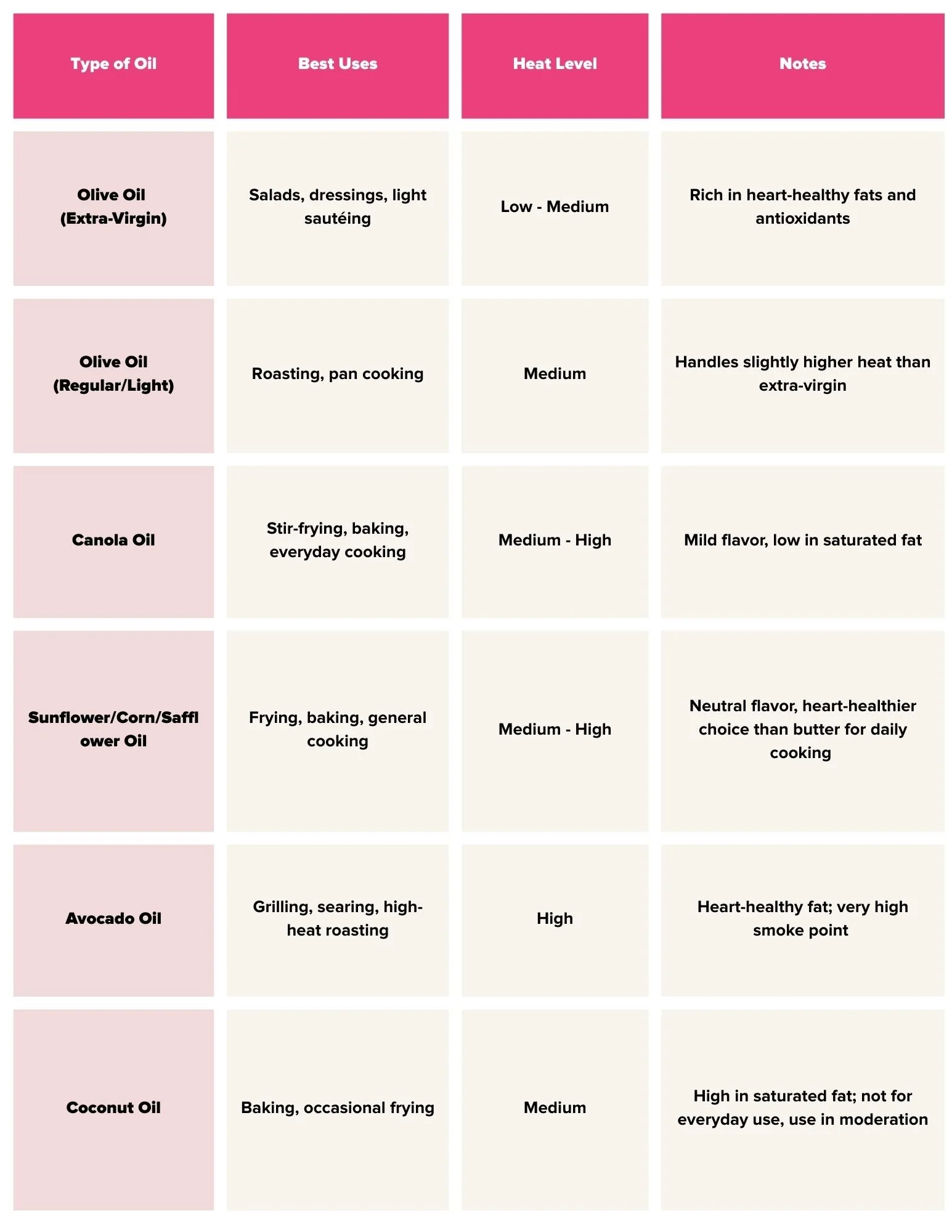
Common cooking oils and how to use them (1,2,4)
Storage Tips: (1-2)
Keep oils in cool, dark places away from the stove or direct sunlight
Seal tightly after each use to keep it fresh
Some oils, like extra-virgin olive oil, may last 6-12 months, while refined oils may last longer
If your oil smells rancid or bitter, it’s time to discard it
So… should you switch oils?
When my family asked whether to switch oils, the answer was simple:
If the oil you’ve been using is mostly unsaturated (like olive or canola oil) and you use it in moderate amounts, there’s no urgent need to change.
Many families find it helpful to keep:
One oil for flavor (like extra-virgin olive oil)
One oil for higher heat (like canola or avocado oil)
You don’t need too many kinds. Two is enough.
The bottom line (1-5)
Most common plant-based cooking oils can be part of a healthy family diet.
Instead of worrying whether an oil is “good” or “bad”, focus on:
Choosing oils higher in unsaturated fats
Limiting saturated fats
Using the right oil for the right cooking method
Building balanced meals over time
Small, steady choices add up. Healthy eating is not about one food, it’s about good habits that last.
Always consult with your paediatrician or a registered dietitian for personalized advice, especially if your child has allergies or special health conditions.
References
Spriet L. Cooking oils 101: A dietitian’s guide to healthy oils [Internet]. London (ON): NutriProCan. 2025 Oct 08 [cited 2026 Feb 23]; [about 8 screens]. Available from: https://nutriprocan.ca/healthy-oils/
Health Essentials. Choosing and using cooking oils: What to use and when [Internet]. Cleveland (OH): Cleveland Clinic. 2023 Jan 18 [cited 2026 Feb 23]; [about 7 screens]. Available from: https://health.clevelandclinic.org/how-to-choose-and-use-healthy-cooking-oils
Goodman H. Expand you healthy cooking oil choices [Internet]. Boston (MA): Harvard Health Publishing @ Harvard Medical School. 2021 Jun 01 [cited 2026 Feb 23]; [about 3 screens]. Available from: https://www.health.harvard.edu/staying-healthy/expand-your-healthy-cooking-oil-choices
Unlock Food. How to use different oils when cooking [Internet]. Toronto (ON): Dietitians of Canada. 2018 Jun 13 [cited 2026 Feb 23]; [about 3 screens]. Available from: https://www.unlockfood.ca/en/Articles/Cooking-And-Food/Cooking-Methods/How-To-Use-Different-Oils-When-Cooking
The Heart and Stroke Foundation of Canada. Dietary fats, oils and cholesterol [Internet]. Toronto (ON): The Heart and Stroke Foundation of Canada. [cited 2026 Feb 23]; [about 8 screens]. Available from: https://www.heartandstroke.ca/healthy-living/healthy-eating/fats-and-oils
Comprendre les huiles de cuisson: un guide simple pour les familles
Écrit par Gladys Chiu, étudiante en nutrition
Il y a quelques jours, ma famille n’avait plus d’huile de cuisson. Avant d’aller faire l’épicerie, mes parents m’ont demandé: «Est-ce qu’on rachète la même huile? Ou est-ce qu’on devrait en choisir une meilleure pour la santé?»
C’est une question simple, mais que j’entends souvent de la part des parents. Avec autant de choix à l’épicerie et autant d'informations en ligne, il peut être facile de s’y perdre.
Voyons cela de façon claire et simple.
Pourquoi utilisons-nous de l’huile? (1-5)
L’huile est un type de gras. Notre corps a besoin de gras pour :
Fournir de l’énergie
Aider à absorber certaines vitamines (A, D, E et K)
Favoriser la croissance et le développement des enfants
Le type de gras que nous choisissons a son importance. Il en existe principaux à connaître:
Les gras insaturés: on les trouve généralement dans les huiles végétales. Ils sont meilleurs pour la santé du cœur.
Les gras saturés: on les trouve notamment dans le beurre, le saindoux et l’huile de noix de coco. Il est préférable d’en limiter la consommation.
Il n’est pas nécessaire d’éviter les huiles. L’objectif est de choisir des options plus saines la plupart du temps.
Certaines huiles sont-elles «toxiques»? (1-3)
Vous entendrez peut-être certaines personnes affirmer que les «huiles de graines», comme l’huile de canola ou l’huile de tournesol, sont nocives.
Selon la Fondation des maladies du cœur et de l’AVC du Canada, cette idée n’est pas appuyée par des données probantes solides.
Ces huiles végétales:
Sont principalement composées de gras insaturés;
Peuvent aider à réduire le cholestérol LDL («mauvais» cholestérol) lorsqu’elles remplacent les gras saturés;
Sont sans danger lorsqu’elles sont utilisées de façon appropriée et ne sont pas surchauffées.
Tous les gras devraient être consommés avec modération, mais les huiles de cuisson courantes ne sont pas «toxiques».
Qu’est-ce que c’est le «point de fumée»? (1-3)
Chaque huile possède un point de fumée, soit la température à laquelle elle commence à fumer et à se dégrader.
Lorsque l’huile commence à fumer:
Elle commence à se dégrader
Elle peut donner aux aliments un goût amer ou brûlé
C’est un signe que la température est trop élevée
Pour la cuisson à température élevée (comme la friture), choisissez une huile ayant un point de fumée élevé, comme l’huile de canola raffinée ou l’huile d’avocat. Si votre huile commence à fumer, réduisez la chaleur.
Les huiles de cuisson courantes et comment les utiliser (1, 2, 4)
Conseils de conservation : (1-2)
Conservez les huiles dans un endroit frais et sombre, loin de la cuisinière et de la lumière directe du soleil.
Refermez bien le contenant après chaque utilisation afin de préserver la fraîcheur de l’huile.
Certaines huiles, comme l’huile d’olive extra vierge, peuvent se conserver de 6 à 12 mois, tandis que les huiles raffinées peuvent se conserver plus longtemps.
Si votre huile dégage une odeur rance ou a un goût amer, il est temps de la jeter.
Alors… devriez-vous changer d’huile?
Lorsque ma famille m’a demandé si nous devions changer d’huile, la réponse était simple:
Si l’huile que vous utilisez est principalement composée de gras insaturés, comme l’huile d’olive ou l’huile de canola, et que vous l’utilisez en quantité modérée, il n’est pas urgent de changer.
De nombreuses familles trouvent pratique d’avoir:
Une huile pour la saveur, comme l’huile d’olive extra vierge
Une huile pour la cuisson à température élevée, comme l’huile de canola ou l’huile d’avocat.
Vous n’avez pas besoin d’avoir beaucoup de variétés. Deux peuvent suffire.
En résumé (1-5)
La plupart des huiles de cuisson végétales courantes peuvent faire partie d’une alimentation familiale saine.
Plutôt que de vous demander si une huile est «bonne» ou «mauvaise», concentrez-vous sur les éléments suivants:
Choisir des huiles riches en gras insaturés
Limiter les gras saturés
Utiliser l’huile qui convient à la méthode de cuisson
Préparer des repas équilibrés au fil du temps
Les petits choix faits régulièrement finissent par s’additionner. Une alimentation saine ne repose pas sur un seul aliment, mais sur de bonnes habitudes qui durent dans le temps.
Consultez toujours votre pédiatre ou un ou une diététiste pour obtenir des conseils personnalisés, particulièrement si votre enfant souffre d’allergies ou présente des problèmes de santé particuliers.