

After-School Hunger: Why it Happens and Ideas for What to Serve
Written by summerlunch+ staff Katelyn Maclellan
Lots of families know the “I’m starving!” moment right after getting home from school. Even when sent to school with a full lunchbox, kids still sometimes come home extra hungry after a busy day of learning, playing, and growing.
This after-school hunger is normal, and a balanced snack can help! Snacks can help bridge the gap between meals, give kids energy, and provide important nutrients.
Why Does this After-School Hunger Happen?
Kids are using energy all day at school. All of the activities that make up a school day, such as learning, recess, gym class, and socializing, can increase a child’s appetite. On some days, kids may come home hungrier than others, even when they’ve eaten the same amount as usual. Kids also have smaller stomachs, which can make it harder to eat enough at meals to carry them through the entire day.
The amount children eat can vary for many reasons. Health Canada notes that growth, activity levels, and emotions can all affect a child’s appetite. Some days, kids might feel extra hungry simply because their bodies are growing. Growth spurts are one reason why kids might eat more one day and less another.
Emotions can affect appetite too. Excitement, stress, or sadness may change how much a child eats from one day to the next. Kids may not always recognize or explain that they are hungry. Sometimes hunger shows up as being tired, frustrated, or having difficulty concentrating.
Why Snacks Are Important
Snacks can be an important part of a child’s eating pattern. The Canadian Paediatric Society says children need 3 meals a day and 1 to 3 snacks, and that healthy snacks are just as important as food served at meals. Snacks are another opportunity to offer nutritious foods to children throughout the day that support their growth and development.
Younger kids often benefit from regular snacks because they may not eat enough at meals to meet all their energy and nutrient needs. Older kids might need snacks to keep their energy levels up throughout the day. An after-school snack gives kids a chance to refuel and helps with their varying levels of hunger from day to day.
What Makes Up a Balanced Snack?
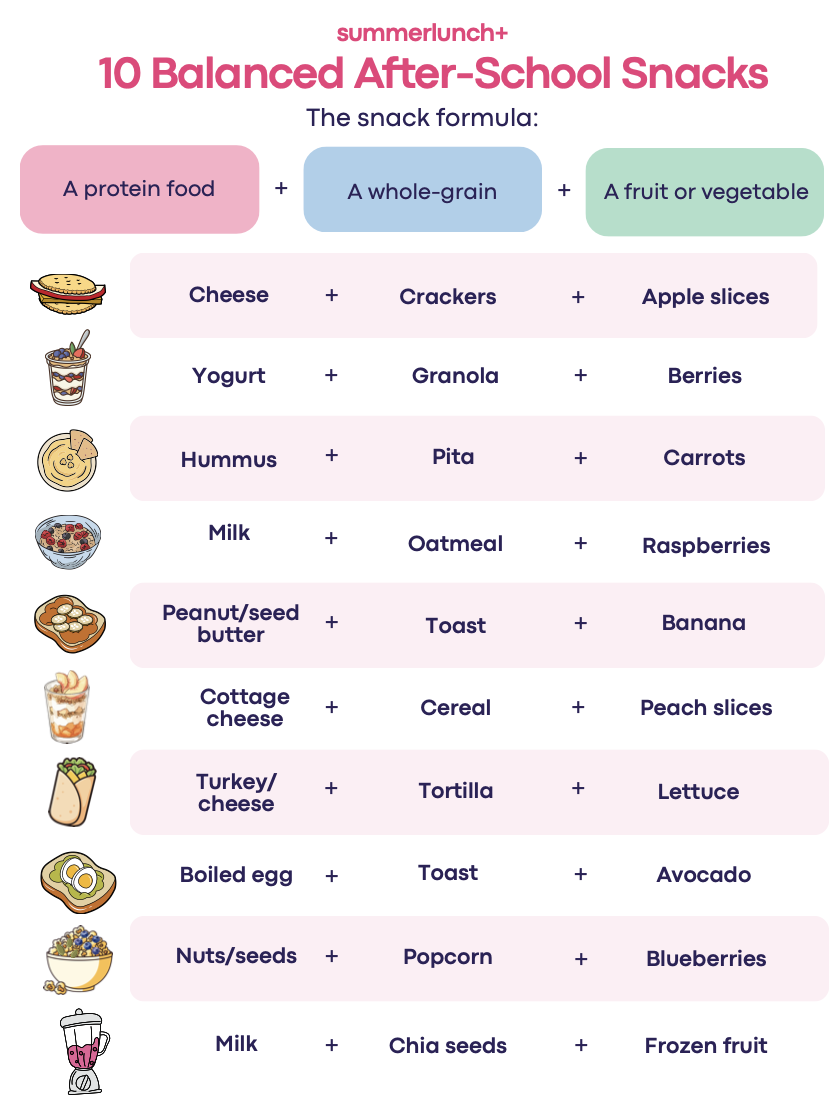
Here is a simple formula to build a tasty and nutritious after-school snack:
A protein food
A whole-grain
A fruit or vegetable
Combining at least two of these groups makes a snack that is satisfying and nutritious.
Young children might have smaller appetites. Health Canada encourages not focusing too much on how much children are eating and to let children decide how much they eat.
To manage this, try starting with smaller portions and let kids ask for more if they are still hungry. Some days, one small snack will be enough. Other days, they might need more. Appetite can naturally vary depending on activity level that day, growth spurts, and emotions.
Remember, the goal isn’t to make every snack “perfect”, but to offer kids satisfying and nourishing snacks that bridge the gap between meals.
Bottom Line
After school hunger is normal and can vary a lot from day to day. Kids spend their days learning, playing, and growing, which uses a lot of energy. A balanced after-school snack is a simple way to help them refuel after a long day at school.
Snack time does not need to be complicated. Use our simple snack formula, or download our handout for 10 balanced after-school snacks that are easy to put together.
La faim après l’école: causes et idées de collations à servir
Écrit par Katelyn Maclellan, membre de l'équipe summerlunch+
Beaucoup de familles connaissent bien ce moment où les enfants s'écrient « J’ai une faim de loup! » dès leur retour de l'école. Même lorsqu’ils partent à l'école avec une boîte à lunch bien remplie, les enfants rentrent parfois à la maison avec une faim de loup après une journée bien remplie passée à apprendre, à jouer, et à grandir.
Cette faim après l'école est tout à fait normale, et une collation équilibrée peut aider! Les collations permettent de combler le vide entre les repas, de donner de l'énergie aux enfants et de leur apporter des nutriments essentiels.
Pourquoi cette faim après l'école se manifeste-t-elle?
Les enfants dépensent de l'énergie toute la journée à l'école. Toutes les activités qui composent une journée scolaire, comme l’apprentissage, la récréation, le cours d'éducation physique et les interactions sociales, peuvent augmenter l'appétit d’un enfant. Certains jours, les enfants peuvent rentrer à la maison plus affamés que d’autres, même s’ils ont mangé la même quantité que d’habitude. De plus, les enfants ont un estomac plus petit, ce qui peut rendre plus difficile de manger suffisamment lors des repas pour tenir toute la journée.
La quantité de nourriture consommée par les enfants peut varier pour de nombreuses de raisons. Santé Canada souligne que la croissance, le niveau d'activité et les émotions peuvent tous influer sur l'appétit d’un enfant. Certains jours, les enfants peuvent avoir davantage faim simplement parce que leur corps est en pleine croissance. Les poussées de croissance sont l’une des raisons pour lesquelles les enfants peuvent manger plus un jour et moins un autre.
Les émotions peuvent également influer sur l'appétit. La surstimulation, le stress ou la tristesse peuvent faire varier la quantité de nourriture qu’un enfant mange d’un jour à l'autre. Les enfants ne sont pas toujours capables de reconnaître ou d’expliquer qu’ils ont faim. Parfois, la faim se manifeste par de la fatigue, de la frustration ou des difficultés de concentration.
Pourquoi les collations sont-elles importantes?
Les collations peuvent constituer un élément important des habitudes alimentaires d’un enfant. La Société canadienne de pédiatrie indique que les enfants ont besoin de trois repas par jour et d’une à trois collations, et que des collations saines sont tout aussi importantes que les aliments servis lors des repas. Les collations constituent une occasion supplémentaire d’offrir aux enfants, tout au long de la journée, des aliments nutritifs qui favorisent leur croissance et leur développement.
Les jeunes enfants tirent souvent profit de collations régulières, car il arrive qu’ils ne mangent pas suffisamment lors des repas pour combler tous leurs besoins énergétiques et nutritionnels. Les enfants plus âgés peuvent avoir besoin de collations pour maintenir leur niveau d'énergie tout au long de la journée. Une collation après l'école permet aux enfants de refaire le plein d'énergie et aide à répondre à leur faim, qui varie d’un jour à l'autre.
Qu’est-ce qui compose une collation équilibrée?
Voici une formule simple pour préparer une collation savoureuse et nutritive après l'école:
Un aliment protéiné
Un aliment à grains entiers
Un fruit ou légume
En combinant au moins deux de ces groupes, on obtient une collation satisfaisante et nutritive.
Les jeunes enfants peuvent avoir un appétit plus modeste. Santé Canada recommande de ne pas trop se focaliser sur la quantité que les enfants mangent et de les laisser décider eux-mêmes de la quantité qu’ils consomment.
Pour y parvenir, essayez de commencer par de petites portions et laissez les enfants en demander s’ils ont encore faim. Certains jours, une petite collation suffira. D’autres jours, ils pourraient en avoir besoin de plus. L'appétit peut naturellement varier selon le niveau d'activité de la journée, les poussées de croissance et les émotions.
N’oubliez pas que l’objectif n'est pas de rendre chaque collation « parfaite », mais d’offrir aux enfants des collations satisfaisantes et nourrissantes qui comblent le vide entre les repas.
En résumé
Il est normal d’avoir faim après l’école, et cette faim peut varier considérablement d’un jour à l’autre. Les enfants passent leurs journées à apprendre, à jouer et à grandir, ce qui leur demande beaucoup d’énergie. Une collation équilibrée après l’école est un moyen simple de les aider à refaire le plein d’énergie après une longue journée d’école.
L’heure de la collation n’a pas besoin d'être compliquée. Utilisez notre formule simple pour les collations, ou téléchargez notre fiche proposant 10 collations équilibrées après l'école, faciles à préparer.