

Is Eating Easy? Understanding the Sensory Journey of Learning to Eat
Written by Samantha Rocca, Registered Dietitian
As parents, it can be easy to think of eating as something that should simply come naturally. After all, we eat every day. We sit down, pick up our food, take a bite, chew, swallow and move on.
But for a child who is learning to eat and gaining more autonomy every day, it is not this simple.
Eating is a complex physical and mental task. Understanding what is involved can change the way we look at picky eating, messy mealtimes, food refusal, and even the funny ways children interact with food.
One approach that helps explain this is the SOS Approach to Feeding (Sequential-Oral-Sensory). Developed by Dr. Kay Toomey (a pediatric psychologist), the SOS Approach looks at feeding as a whole-body skill.
At the heart of the approach is the rather simple idea that eating doesn't begin when food goes into a child's mouth.
Even something as simple as swallowing requires coordination. Just one swallow involves the coordination of almost 26 muscles and 6 cranial nerves working together (Matsuo & Palmer, 2008).
We often hear and think about the five senses and how they may be involved in eating:
Sight
Touch
Hearing
Smell
Taste
Eating isn't just about taste. As outlined by Fraser Health, our bodies simultaneously rely on three hidden internal senses alongside the five sense mentioned above to coordinate every single bite:
1. Proprioceptive: Information from our muscles and joints that helps us understand where our body is and how it is moving.
Tells you where your body parts are in the moment.
Helps you judge how much force to use when chewing or holding a fork.
2. Vestibular: Information related to balance and our body's orientation in space.
Keep your head and body steady while you sit and eat.
Helps you stay upright in your chair.
3. Interoception: Awareness of internal body signals such as hunger, fullness, temperature, and other sensations.
Notices stomach growls or feelings of fullness.
Tells you when you are hungry or thirsty and when to stop eating.
So when your child sits down with a piece of food, their brain isn't simply asking, “Do I like this?” It is processing an enormous amount of information: What does it look like? What does it smell like? What will it feel like? Is it familiar? Is it safe? What will happen if I touch it? What will happen if I put it in my mouth? Can my body manage this texture?
There is a developmental process involved each time a child is eating!
The SOS Approach (Toomey & Ross, 2011) describes six major Steps to Eating:
1. Tolerates the food
2. Interacts with the food
3. Smells the food
4. Touches the food
5. Tastes the food
6. Eats the food
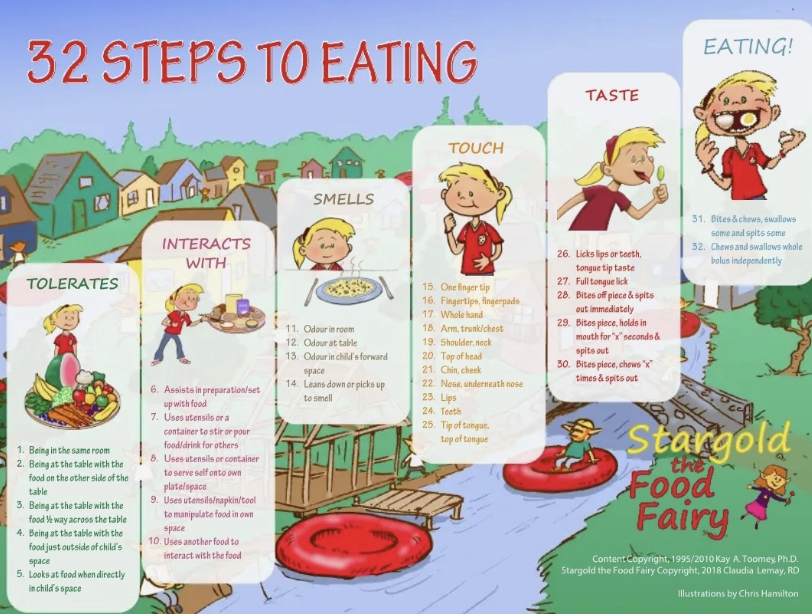
These six steps are a way for parents to understand the bigger picture. Within them is a much more detailed hierarchy of skills. There are 25 steps for typically developing children and 32 or more steps for children experiencing feeding difficulties.
This is why a child who doesn't eat a new food right away may still be making progress.
Imagine you put roasted zucchini on your child's plate.
Your child may first need to be comfortable with the zucchini simply being in the room.
Then they may be able to tolerate it on the table.
Next, perhaps they can tolerate it on their own plate.
Then they might look at it.
Maybe they will touch it with a fork.
Then smell it.
Then touch it with one finger.
Maybe they will pick it up.
Perhaps they'll bring it toward their mouth.
They might touch it with their lips or tongue.
They might put it in their mouth and immediately spit it out.
And eventually, they may be ready to chew and swallow it.
From the outside, it can look like, “They didn't eat the zucchini and they don’t like it”. From a developmental perspective, however, they’ve taken several important steps towards eating it.
If we expect every new food to go directly from plate to mouth to swallowed, we can unintentionally skip many of the steps a child needs in order to feel comfortable with a food. Sometimes, it can help to use gradual progression that allows the child to move toward eating at a pace appropriate to their skills and comfort level. If a child becomes distressed, the goal is not to force them forward. Instead, the adult can adjust and can move back to an earlier step.
What’s the bottom line?
Eating is a skill that develops over time and for some children, that journey takes more steps than we might realize. What looks like “picky eating” or “refusing food” may actually be a child working through the sensory, motor, and developmental skills they need to feel safe and successful with food.
When we recognize that eating doesn’t begin with taking a bite, we can start to notice and celebrate the smaller steps along the way: tolerating a food nearby, looking at it, touching it, smelling it, tasting it, and eventually eating it.
Progress at the table isn't always measured by how much a child eats. Sometimes, progress is simply becoming a little more comfortable with food.
References:
Toomey, Kay & Ross, Erin. (2011). SOS Approach to Feeding. Perspectives on Swallowing and Swallowing Disorders (Dysphagia). 20. 82-87. 10.1044/sasd20.3.82.
Matsuo, Koichiro, & Palmer, Jeffrey B. (2008). Anatomy and physiology of feeding and swallowing: normal and abnormal. Physical medicine and rehabilitation clinics of North America. 19. 691-707, vii. 10.1016/j.pmr.2008.06.001
Fraser. (2022). What an activity like eating can teach you about sensory processing differences. Fraser. https://www.fraser.org/resources/blog/what-an-activity-like-eating-can-teach-you-about-sensory-processing-differences-
Manger, est-ce facile? Comprendre le parcours sensoriel de l’apprentissage de l’alimentation
Écrit par Samantha Rocca, Diététiste agréée
En tant que parents, on a souvent tendance à considérer que manger est quelque chose qui devrait venir tout naturellement. Apres tout, on mange tous les jours. On s’assoit, on prend son assiette, on croque un morceau, on mâche, on avale, puis on passe à autre chose.
Mais pour un enfant qui apprend à manger et qui gagne chaque jour un peu plus d’autonomie, ce n’est pas aussi simple que ça.
Manger est une activité physique et mentale complexe. Comprendre ce qu’elle implique peut changer notre façon d’envisager la sélectivité alimentaire, les repas désordonnés, le refus de manger et même les comportements amusants des enfants face à la nourriture.
Une approche qui aide à expliquer cela est l’approche SOS (Sequential-Oral-Sensory) de l’alimentation. Développée par la Dre Kay Toomey (psychologue pédiatrique), l’approche SOS considère l’alimentation comme une compétence faisant appel à l’ensemble du corps.
Au cœur de cette approche se trouve l’idée assez simple selon laquelle manger ne commence pas lorsque la nourriture entre dans la bouche de l’enfant.
Même un geste aussi simple que la déglutition nécessite une coordination. Une seule déglutition implique la coordination de près de 26 muscles et de 6 nerfs crâniens travaillant ensemble (Matsuo et Palmer, 2008).
On entend souvent parler des cinq sens et de la façon dont ils peuvent intervenir dans l’alimentation:
La vue
Le toucher
L'ouïe
L’odorat
Le goût
Manger ne se résume pas seulement au goût. Comme l’explique Fraser Health, notre corps fait appel simultanément à trois sens internes cachés, en plus des cinq sens mentionnés ci-dessus, pour coordonner chaque bouchée:
1. Proprioception: les informations provenant de nos muscles et de nos articulations qui nous aident à comprendre où se trouve notre corps et comment il bouge.
Elle vous indique où se trouvent les différentes parties de votre corps à un moment donné.
Elle vous aide à évaluer la force à exercer lorsque vous mâchez ou que vous tenez une fourchette.
2. Système vestibulaire: les informations liées à l’équilibre et à l’orientation de notre corps dans l’espace.
Permet de garder la tête et le corps stables lorsque vous êtes assis et que vous mangez.
Aide à rester droit sur votre chaise.
3. Interoception: Perception des signaux internes du corps, tels que la faim, la satiété, la température et d’autres sensations.
Détecte les gargouillements d’estomac ou les sensations de satiété.
Indique quand vous avez faim ou soif et quand vous devez cesser de manger.
Ainsi, lorsque votre enfant s’assoit avec un morceau de nourriture, son cerveau ne se contente pas de se demander : « Est-ce que j’aime ça? » Il traite une quantité énorme d’informations : À quoi cela ressemble-t-il? Quelle est son odeur? Quelle sensation cela va-t-il procurer? Est-ce familier? Est-ce sans danger? Que se passera-t-il si je le touche? Que se passera-t-il si je le mets dans ma bouche? Mon corps peut-il gérer cette texture?
Chaque fois qu’un enfant mange, il s’agit d’un processus de développement!
L’approche SOS (Toomey et Ross, 2011) décrit six étapes principales de l’alimentation:
1. Tolérer la nourriture
2. Interagir avec la nourriture
3. Sentir la nourriture
4. Toucher la nourriture
5. Goûter la nourriture
6. Manger la nourriture
Ces six étapes permettent aux parents d’avoir une vue d’ensemble. Elles recouvrent en réalité une hiérarchie de compétences beaucoup plus détaillée. On dénombre 25 étapes pour les enfants au développement typique et 32 étapes ou plus pour les enfants présentant des difficultés alimentaires.
C’est pourquoi un enfant qui n’accepte pas tout de suite un nouvel aliment peut tout de même faire des progrès.
Imaginez que vous mettiez des courgettes rôties dans l’assiette de votre enfant.
Il se peut que votre enfant ait d’abord besoin de s’habituer à la simple présence des courgettes dans la pièce.
Ensuite, il pourra peut-être les tolérer sur la table.
Puis, il pourra peut-être les tolérer dans sa propre assiette.
Après, il les regardera peut-être.
Peut-être les touchera-t-il avec une fourchette.
Puis il les sentira.
Ensuite, il les touchera avec un doigt.
Peut-être les prendra-t-il dans sa main.
Peut-être la portera-t-il vers sa bouche.
Il pourrait la toucher avec ses lèvres ou sa langue.
Il pourrait la mettre dans sa bouche et la recracher immédiatement.
Et finalement, il pourrait être prêt à la mâcher et à l’avaler.
Vu de l’extérieur, on pourrait penser : « Il n’a pas mangé la courgette et il ne l’aime pas ». Du point de vue du développement, cependant, il a franchi plusieurs étapes importantes pour arriver à la manger.
Si nous nous attendons à ce que chaque nouvel aliment passe directement de l’assiette à la bouche puis soit avalé, nous risquons, sans le vouloir, de sauter plusieurs des étapes dont un enfant a besoin pour se sentir à l’aise avec un aliment. Parfois, il peut être utile d’adopter une approche progressive qui permet à l’enfant d’évoluer vers la consommation de cet aliment à un rythme adapté à ses capacités et à son niveau de confort. Si un enfant se montre en détresse, l’objectif n’est pas de le forcer à aller de l’avant. L’adulte peut plutôt s’adapter et revenir à une étape antérieure.
En fin de compte, qu’en est-il?
Manger est une compétence qui s’acquiert avec le temps et, pour certains enfants, ce parcours comporte plus d’étapes qu’on ne le pense. Ce qui ressemble à de la « sélectivité alimentaire » ou à un « refus de manger » peut en réalité correspondre à un enfant qui acquiert les compétences sensorielles, motrices et développementales dont il a besoin pour se sentir en sécurité et réussir ses expériences alimentaires.
Lorsque nous reconnaissons que manger ne commence pas par prendre une bouchée, nous pouvons commencer à remarquer et à célébrer les petites étapes du parcours : tolérer la présence d’un aliment à proximité, le regarder, le toucher, le sentir, le goûter et, finalement, le manger.
Les progrès à table ne se mesurent pas toujours à la quantité qu’un enfant mange. Parfois, le progrès consiste simplement à se sentir un peu plus à l’aise avec la nourriture.